Saturday, December 6, 2014

St. Katherine ~ Feast Day is this Sunday

Note: we begin each Sunday School this way:

1. We remind the kids of the Jesus Prayer is:
Lord Jesus Christ have mercy on me.
We take the blue bag of prayer ropes and hand one out to each child.
We say the prayer together out loud about 7 times or so.

2. If there are any new children we write down their names, 
birthday, names day and date of names day.
About this time we pass out the first cracker, of which they will be quite excited about.

3. Then we begin the lesson.


For teacher's reference: 


"Catherine was the daughter of King Constus. After the death of her father, she lived with her mother in Alexandria. Her mother was secretly a Christian who, through her spiritual father, brought Catherine to the Christian Faith. In a vision, St. Catherine received a ring from the Lord Jesus Himself as a sign of her betrothal to Him. This ring remains on her finger even today. Catherine was greatly gifted by God and was well educated in Greek philosophy, medicine, rhetoric and logic. In addition to that, she was of unusual physical beauty. When the iniquitous Emperor Maxentius offered sacrifices to the idols and ordered others to do the same, Catherine boldly confronted the emperor and denounced his idolatrous errors. The emperor, seeing that she was greater than he in wisdom and knowledge, summoned fifty of his wisest men to debate with her on matters of faith and to put her to shame. Catherine outwitted and shamed them. In a rage, the emperor ordered all fifty of those men burned. By St. Catherine's prayers, all fifty confessed the name of Christ and declared themselves Christians before their execution. After Catherine had been put in prison, she converted the emperor's commander, Porphyrius, and two hundred soldiers to the true Faith, as well as Empress Augusta-Vasilissa herself. They all suffered for Christ. During the torture of St. Catherine, an angel of God came to her and destroyed the wheel on which the holy virgin was being tortured. Afterward, the Lord Jesus Christ Himself appeared to her and comforted her. After many tortures, Catherine was beheaded at the age of eighteen, on November 24, 310. Milk, instead of blood, flowed from her body. Her miracle-working relics repose on Mount Sinai."
*
This lesson will begin with the children seeing the icon of St. Katherine that is above.  
I have a laminate copy to show them that they can pass around and see. 
As when we have other feast days, we talk about the icon for a bit before hearing the
story about the feast day or Saint.
*
The following is what I am going to tell the children... as we have some children who are only 4  
years of age in the class, the story will exclude a detailed recitation of St. Katherine's sufferings.  It is more important to communicate St. Katherine's love of Christ and that she would choose death over losing Christ by denying Him.  But scaring the children unduly is not circumspect.  

I broke up the story below with a *** so that it is clear to me
(as I print out the lesson to help me) where to tell the story more directly 
and when to start telling the story with the focus being on the bolded sections.

I hope to get this book for next year, DV 
but have the icon of St. Katherine to bring with me
and to show the kids and help tell the story with.
*
From the Orthodox Wiki:

Living in the capital—the centre of Hellenistic knowledge—and possessed of an uncommon beauty and intellect, Catherine received a most splendid of educations, having studied the works of the finest philosophers and teachers of antiquity. Young men from the most worthy families of the empire sought the hand of the beautiful Catherine, but none of them was chosen. She declared to her parents that she would be agreeable to enter into marriage only with someone who surpassed her in illustriousness, wealth, comeliness, and wisdom.
Catherine's mother, a secret Christian, sent her for advice to her own spiritual father—a saintly elder pursuing prayerful deeds in solitude in a cave not far from the city. Having listened to Catherine, the elder said that he knew of a youth who surpassed her in everything, such that "His beauty was more radiant than the shining of the sun, his wisdom governed all creation, his riches were spread throughout all the world—this however did not diminish but rather added to the inexpressible loftiness of his lineage." The image of the heavenly Bridegroom produced in the soul of the holy maiden an ardent desire to see him. Truth, to which her soul yearned, revealed it to her. In parting, the elder handed Catherine an icon of the Mother of God with the God-Child Jesus on her arm and bid her to pray with faith to the Queen of Heaven—the Mother of the Heavenly Bridegroom—for the bestowing of the vision of Her Son.
Catherine prayed all night and was given to see the Most Holy Virgin, who sent her divine Son to look upon the kneeling of Catherine before Them. But the Child turned his face away from her saying, that he was not able to look at her because she was ugly, of shabby lineage, beggarly and mindless like every person—not washed with the waters of holy Baptism and not sealed with the seal of the Holy Spirit. Catherine returned again to the elder deeply saddened. He lovingly received her, instructed her in the faith of Christ, admonished her to preserve her purity and integrity and to pray unceasingly; he then performed over her the mystery/sacrament of holy baptism. And again Saint Catherine had a vision of the Mother of God with her Child. Now the Lord looked tenderly at her and gave her a ring—a wondrous gift of the heavenly Bridegroom.
*****
St. Catherine of Alexandria
At this time the emperor Maximinus was himself in Alexandria for a pagan feast day. Because of this, the feast was especially splendid and crowded. The cries of the sacrificial animals, the smoke and the smell of the sacrifices, the endless blazing of fires, and the bustling crowds at the arenas filled Alexandria. Human victims also were brought—because they consigned to death in the fire the confessors in Christ, those not recanting from him under torture. The saint's love for the Christian martyrs and her fervent desire to lighten their fate impelled Catherine to go to the pagan head-priest and ruler of the empire, the emperor-persecutor Maximinus.
Introducing herself, the saint confessed her faith in the one true God and with wisdom denounced the errors of the pagans. The beauty of the maiden captivated the emperor. In order to convince her and show the superiority of pagan wisdom, the emperor gave orders to gather 50 of the most learned men (rhetoricians) of the empire, but the saint got the better of the wise men, such that they themselves came to believe in Christ. Saint Catherine shielded the martyrs with the sign of the cross, and they bravely accepted death for Christ and were burnt by order of the emperor.
Maximinus, no longer hoping to convince the saint, tried to entice her with the promise of riches and fame. Having received an angry refusal, the emperor gave orders to subject the saint to terrible tortures and then throw her in prison. The Empress Augusta, who had heard much about the saint, wanted to see her. Having prevailed upon the military-commander Porphyry to accompany her with a detachment of soldiers, Augusta went to the prison. The empress was impressed by the strong spirit of St. Catherine, whose face glowed with Divine grace. The holy martyr explained the Christian teaching to the newly-arrived, and they in believing were converted to Christ.
On the following day they again brought the martyr to the judgement court where, under the threat of being broken on the wheel, they urged that she recant from the Christian faith and offer sacrifice to the gods. The saint steadfastly confessed Christ and she herself approached the wheels; but an angel smashed the instruments of execution, which broke up into pieces with many pagans passing nearby. Having beheld this wonder, the empress Augusta and the imperial courtier Porphyry with 200 soldiers confessed their faith in Christ in front of everyone, and they were beheaded. Maximinus again tried to entice the holy martyr, proposing marriage to her, and again he received a refusal. St. Catherine firmly confessed her fidelity to the heavenly Bridegroom, Christ, and with a prayer to him she herself put her head on the block under the sword of the executioner. The relics of St. Catherine were taken by the angels to Mount Sinai. In the 9th or 10th century, through a revelation, the incorrupt relic of the holy martyress were found and transferred with honour to the church of Sinai monastery, built by the holy emperor Justinian the Great in the 6th century. To this day, the Great Martyr's venerable head and left hand are presented for veneration by the Fathers of the Holy Monastery for the veneration of the faithful. ~ Orthodox Wiki
*
Craft Time:
If time permits, 
we will have a drawing time for them to draw
St. Katherine and how much she loved Christ and how
He came to her twice with His Holy Mother. 

Sunday, November 30, 2014

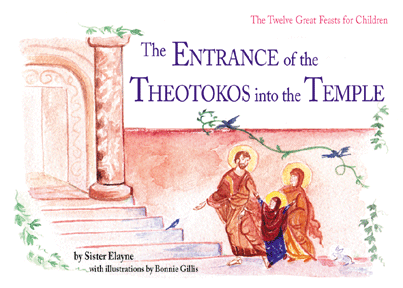
Entrance of the Theotokos


Note: we begin each Sunday School this way:

1. We remind the kids of the Jesus Prayer is:
Lord Jesus Christ have mercy on me.
We take the blue bag of prayer ropes and hand one out to each child.
We say the prayer together out loud about 7 times or so.

2. If there are any new children we write down their names, 
birthday, names day and date of names day.
About this time we pass out the first cracker, of which they will be quite excited about.

3. Then we begin the lesson.


We will be reading this book 
for the future feast
later this week.

Saturday, November 29, 2014

{Last Week} ~ Saint Martin of Tours

Last week,
after our Jesus prayers,
we read a lovely book on Saint Martin of Tours
whose day was this past Monday.


You can order this book here.

Sunday, November 9, 2014

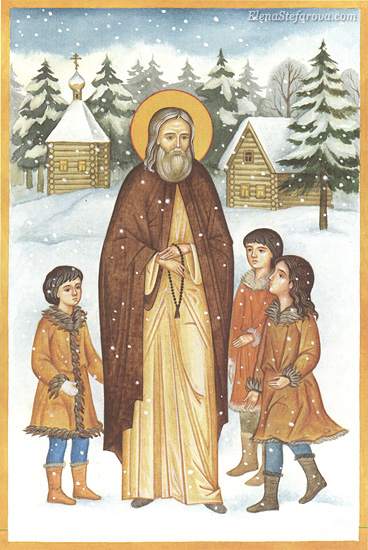
{Learning about the Saints} ~ Saint Herman of Alaska

Note: we begin each Sunday School this way:

1. We remind the kids of the Jesus Prayer is:
Lord Jesus Christ have mercy on me.
We take the blue bag of prayer ropes and hand one out to each child.
We say the prayer together out loud about 7 times or so.

2. If there are any new children we write down their names, 
birthday, names day and date of names day.
About this time we pass out the first cracker, of which they will be quite excited about.

3. Then we begin the lesson.


Today I am going to speak to the children about
As last week's lesson was on St. John of Kronstadt, 
the first things that will be talked about is reminding them of St. John
and how he is a great Saint who loves children.
*
St. Herman is also a Saint who loves children
and who is a special "Father-Daddy" Saint to many.


Saint Herman lived on Spruce Island for many years
and helped children, including orphans, there.
*
This book on Saint Herman has a lot about his life 
and how he loved children.


Do you know that you can talk to St. Herman
and ask his prayers?
Did you know that the Saints want to help us
and be our Holy Friends?
*
Craft Idea:

Draw a picture of Saint Herman and something he did while
living on earth.
Some examples are below:


Holy Saint Herman pray to God for us!

Saturday, November 1, 2014

St. John of Kronstadt ~ Loving and Caring for Children!

Note: we begin each Sunday School this way:

1. We remind the kids of the Jesus Prayer is:
Lord Jesus Christ have mercy on me.
We take the blue bag of prayer ropes and hand one out to each child.
We say the prayer together out loud about 7 times or so.

2. If there are any new children we write down their names, 
birthday, names day and date of names day.
About this time we pass out the first cracker, of which they will be quite excited about.

3. Then we begin the lesson.


St. John of Kronstadt is a very beloved Saint to 
many many people!
On the old calendar his day is celebrated on November 1st.

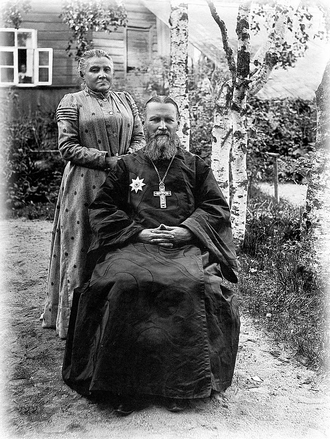
St. John of Kronstadt

St. John lived in Kronstadt Russia and was a 
humble priest married to his Matushka Elizabeth
with who they lived as in a monastery,
full of prayer and love for God and others.


When Saint John was a child he 

"When John was ten, his parents were able to raise some money and send him to the local school which was attached to the church. At first, the boy had an extremely difficult time with his studies. He worked for days on end, but still failed to keep up.

Writing about his life he once recalled an evening when everyone had already gone to bed. “I could not sleep, and I still failed to understand anything I was taught. I still read poorly and could not remember anything I was told. I became so depressed I fell to my knees and began to pray. I don’t know whether I had spent a long time in that position or not, but suddenly something shook my whole being. It was as if a veil had fallen from my eyes, and my mind had been opened, and I remembered clearly my teacher of that day and his lesson. I also recalled the topic and the examples he had given. I felt so light and joyous inside.” After this experience he did so well he became one of the first in his class to be chosen to go to seminary, and after seminary to the Theological Academy in St Petersburg (a great honor at that time)." (source).
*
Now Saint John can help all children as they are in school too!
It is wonderful that the Saints know what it is like
to have been a child and that it is not always easy.
*
Did you know that you can pray to St. John of Kronstadt
for help in school and at home?

st. john of kronstadt bringing children to an orphanage

St. John cared for many children 
and founded an orphanage for them.
St. John cared very much for the poor and did a lot to help them!
*
"Fr. John established a special relief organization. It was called the "House of the Industry" and opened in Kronstadt in 1882. It had its own church, an elementary school for boys and girls, an orphanage, a hospital for anyone who came there, a boarding house, a free public library, shelter for the homeless that accommodated 40,000 people each year, a variety of workshops where the impoverished were able to earn some money, a cheap public canteen which served about 800 free dinners on holidays, and a hostel for the travelers." (source)
*
So we can see that St. John loved families and children very much
and tried to make sure they had all they needed!
*
Many people pray to St. John of Kronstadt for help
We must pray to St. John of Kronstadt too and remember
that he loves us!
*
This week, 
let's try to remember to ask St. John of Kronstadt for help
in our lives as we are at home, church and school.
*****
Craft Idea:

Draw pictures of St. John...
Ideas included:

~St. John praying as a child to God for
help in school

~St. John helping at the church, school, orphanage, and library that 
was part of the House of Industry that he began

~St. John praying in church as a priest

~St. John blessing a house with Holy Water


Sunday, October 19, 2014

The Protection of the Mother of God

Note: we begin each Sunday School this way:

1. We remind the kids of the Jesus Prayer is:
Lord Jesus Christ have mercy on me.
We take the blue bag of prayer ropes and hand one out to each child.
We say the prayer together out loud about 7 times or so.
2. If there are any new children we write down their names,
birthday, names day and date of names day.
About this time we pass out the first cracker, of which they will be quite excited about.

3. Then we begin the lesson.


From time immemorial, the Church has celebrated the Most-holy Theotokos as the patroness and protectress of the Christian people, who, by her intercessory prayers, implores God's mercy for us sinners. The help of the Most-holy Mother of God has been clearly shown numerous times, to individuals and to nations, in peace and in war, in monastic deserts and in densely populated cities. The event that the Church commemorates and celebrates today confirms the Theotokos' consistent protection of Christian people. On October 1, 911, during the reign of Emperor Leo the Wise, there was an All-night Vigil in the Blachernae Church of the Mother of God in Constantinople. The church was full of people. St. Andrew the Fool-for-Christ was standing in the rear of the church with his disciple Epiphanius. At four o'clock in the morning, the Most-holy Theotokos appeared above the people, holding her omophorion outstretched as a protective covering for the faithful. She was clothed in gold-encrusted purple, and shone with an ineffable radiance, surrounded by apostles, saints, martyrs and virgins. St. Andrew said to Blessed Epiphanius: "Do you see, brother, the Queen and Lady of all praying for the whole world?'' Epiphanius replied: "I see, Father, and am struck with amazement!'' The Feast of the Protection was instituted to commemorate this event, and to remind us that we can prayerfully receive the unceasing protection of the Most-holy Theotokos in any time of difficulty.
*

"Today the Virgin stands in the midst of the Church, and with choirs of Saints she invisibly prays to God for us. Angels and Bishops venerate Her, Apostles and prophets rejoice together, Since for our sake she prays to the Eternal God!

This miraculous appearance of the Mother of God occurred in the mid-10th century in Constantinople, in the Blachernae church where her robe, veil, and part of her belt were preserved after being transferred from Palestine in the fifth century. On Sunday, October 1, during the All Night Vigil, when the church was overflowing with those at prayer, the Fool-for-Christ St. Andrew lifted up his eyes towards the heavens and beheld our most Holy Lady Theotokos coming through the air, resplendent with heavenly light and surrounded by an assembly of the Saints. St. John the Baptist and the holy Apostle John the Theologian accompanied the Queen of Heaven. On bended knees the Most Holy Virgin tearfully prayed for Christians.

After completing her prayer, she took her veil and spread it over the people in the church, protecting them from enemies both visible and invisible. She was resplendent with heavenly glory, and the protecting veil in her hands gleamed “more than the rays of the sun.” St. Andrew gazed trembling at the miraculous vision, and he asked his disciple, the blessed Epiphanius standing beside him, “Do you see, brother, the Holy Theotokos, praying for all the world?” Epiphanius answered, “I do see, holy Father, and I am in awe.” The Ever-Blessed Mother of God implored the Lord Jesus Christ to accept the prayers of all the people calling on His Most Holy Name, and to respond speedily to her intercession, “O Heavenly King, accept all those who pray to You and call on my name for help. Do not let them not go away from my icon unheard.” Ss. Andrew and Epiphanius were worthy to see the Mother of God at prayer, and “for a long time observed the Protecting Veil spread over the people and shining with flashes of glory. As long as the Theotokos was there, the Protecting Veil was also visible, but when she departed it became invisible. After taking it with her, she left behind the grace of her visitation.”


Children are very drawn to this icon.
I remember my sister-friend's oldest son 
holding up a copy of this icon in the car,
as he was afraid of animals coming onto the road;
I remember the Munchkin I cared for this summer
saying to himself, after he asked me
what this icon is,
the protection of the Mother of God.
*
The Lesson will be as follows:

1. Show them the above two icons (the full icon and detail of
the Mother of God.)

2. For the full icon, point out various parts: 
the two Saints who see the Mother of God,
how many people are in church at an all night vigil,
St. John the Theologian and St. John the Baptist,
how the Mother of God is above everyone protecting them
with her veil
and how Christ is above all of us, including His Mother 
who she prays to for help for us.

3. Explain that the vigil for was praying for help against
invaders who were trying to overcome the city
and that the Mother of God saved them.

4. That we can ask the Mother of God to protect us too.
Sometimes our struggles do not go away
right away but we can have comfort that
the Mother of God is with us, is still protecting us,
loves us and can help us.

Sunday, October 12, 2014

Some Simple Lessons and Stories about the Jesus Prayer and Our Heart

Note: we begin each Sunday School this way:


1. We remind the kids of the Jesus Prayer is:
Lord Jesus Christ have mercy on me.
We take the blue bag of prayer ropes and hand one out to each child.
We say the prayer together outloud about 7 times or so.
2. If there are any new children we write down their names,
birthday, names day and date of names day.
About this time we pass out the first cracker, of which they will be quite excited about.


3. Then we begin the lesson.


The Jesus Prayer and Me
Doing a lesson on the Jesus Prayer is never wasted!
Ideas for this lesson:
*
Talk to them about where they think they can pray this prayer in their 
own lives ~ can they pray at home? at school? 
How can we remember to do 
"Lord have mercies" at home? 
*
Craft: have them draw places they can pray the Jesus Prayer
and how prayer can help them.
*
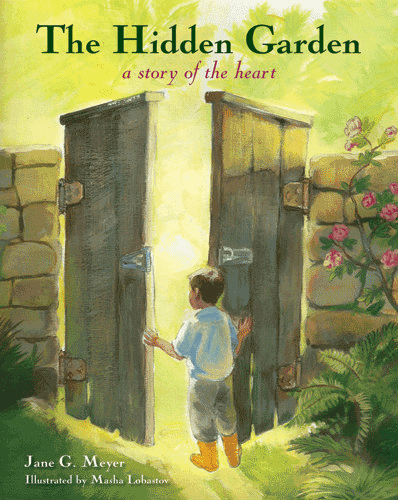
If more time is left, 
you can read them from the book


Which talks about caring for the garden of our heart, 
so very much in line with cultivating the Jesus Prayer 
in our lives. 
*
Be sure to recollect the prayer ropes at the end of class and put them
in the blue drawstring bag! 

Sunday, October 5, 2014

A Simple Lesson on the Heart

Note: we begin each Sunday School this way:

1. We remind the kids of the Jesus Prayer is:

Lord Jesus Christ have mercy on me.
We take the blue bag of prayer ropes and hand one out to each child.
We say the prayer together about 7 times or so.

2. If there are any new children we write down their names, 

birthday, names day and date of names day.
About this time we pass out the first cracker, of which they will be quite excited about.

3. Then we begin the lesson.


*

The lesson today is about how Christ can come
to help us pray.
The lesson is reading from the book

This talks about caring for the garden of our heart, 
so very much in line with cultivating the Jesus Prayer 
in our lives. 
*
In this story who is waiting for us to help us with
the garden of our heart?
*
Remind them of our lesson on the church year,
how Jesus said he came to heal our hearts
so they can be a dwelling place of God.
Show them the icon of Jesus in the temple
saying that the verses He just read in Isaiah are
now fulfilled, come true.
*
This story shows how Jesus is wanting to heal our
hearts by putting wonderful things in
like love, peace and patience.
What are ways that we can love?
Can we ask Jesus to help us love and have
our hearts be filled with good flowers like in the story,
of love, peace, patience, forgiveness?
*
Craft idea:
have the children draw Jesus healing their hearts
and what flowers can grow when Jesus is helping us.
*
Be sure to recollect the prayer ropes at the end of class and put them
in the blue drawstring bag!


Saturday, September 27, 2014

Exaltation of the Cross


Note: we begin each Sunday School this way:

1. We remind the kids of the Jesus Prayer is:

Lord Jesus Christ have mercy on me.
We take the blue bag of prayer ropes and hand one out to each child.
We say the prayer together about 7 times or so.
2. If there are any new children we write down their names, 
birthday, names day and date of names day.
About this time we pass out the first cracker, of which they will be quite excited about.
3. Then we begin the lesson.
We can begin by asking them if they remember the icon that is the middle of church today,

What is it? What Feast day is today?
Did you see the Cross?
Did we bow before it and kiss it?
Today is the Feast of the Exaltation of the Cross!
Show them/pass around the laminate icon of the Feast of the Exaltation of the Cross.
*
Information for the Sunday School Teacher on today:


Two events in connection with the Honorable Cross of Christ are commemorated on this day: first, the finding of the Honorable Cross on Golgotha and second, the return of the Honorable Cross from Persia to Jerusalem. Visiting the Holy Land, the holy Empress Helena decided to find the Honorable Cross of Christ. An old Jewish man named Judah was the only one who knew where the Cross was located, and, constrained by the empress, he revealed that the Cross was buried under the temple of Venus that Emperor Hadrian had built on Golgotha. The empress ordered that this idolatrous temple be razed and, having dug deep below it, found three crosses. While the empress pondered on how to recognize which of these was the Cross of Christ, a funeral procession passed by. Patriarch Macarius told them to place the crosses, one by one, on the dead man. When they placed the first and second cross on the dead man, the dead man lay unchanged. When they placed the third cross on him, the dead man came back to life. By this they knew that this was the Precious and Life-giving Cross of Christ. They then placed the Cross on a sick woman, and she became well. The patriarch elevated the Cross for all the people to see, and the people sang with tears: "Lord, have mercy!'' Empress Helena had a silver case made and set the Honorable Cross in it. Later, the Persian Emperor Chozroes conquered Jerusalem, enslaved many people, and took the Lord's Cross to Persia. The Cross remained in Persia for fourteen years. In the year 628 the Greek Emperor Heraclius defeated Chozroes and, with much ceremony, returned the Cross to Jerusalem. As he entered the city Emperor Heraclius carried the Cross on his back, but suddenly was unable to take another step. Patriarch Zacharias saw an angel preventing the emperor from bearing the Cross on the same path that the Lord had walked barefoot and humiliated. The patriarch communicated this vision to the emperor. The emperor removed his raiment and, in ragged attire and barefoot, took up the Cross, carried it to Golgotha, and placed it in the Church of the Resurrection, to the joy and consolation of the whole Christian world.
From here 
*
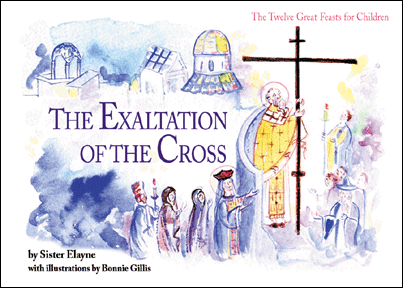
Read the children this book:


Talk about it as seems fit.
Talk about how we wear Crosses and have them blessed in church.
*
Craft Idea:
Have them draw their own Cross for the Feast.
Blessed Feast Day!
*
Be sure to recollect the prayer ropes at the end of class and put them
in the blue drawstring bag!